

They can take tomorrow before it begins.
Less energy for demanding work, patient parenting, physical recovery and the ambitions that require your best.
The danger may be closer than you think
Theirs did.
It damaged their health, disrupted their lives and prevented them from thriving. Your home should do the opposite: quietly help your family sleep, recover, think clearly and live fully.
Written for real homes and real life
•Built around whole-home wellbeing
•Designed for practical action
The life you want requires more than comfort
Thriving requires restorative sleep, clear thinking, sustained energy, healthy breathing and the ability to recover. Your home influences every one of them—every day and every night.
Beyond Comfort helps you recognize what may be holding your family back, understand the forces at work and make better decisions without becoming an indoor-environment expert.
Your clear path forward
A practical framework for understanding how your indoor environment shapes how you feel.
A warning from inside the EPA
A 60 Minutes investigation examined reported illness among employees inside the U.S. Environmental Protection Agency’s own headquarters—showing how difficult an indoor environmental problem can be to recognize, explain and resolve.
If it could happen there, what might be going unnoticed inside an ordinary home?
The symptom is only the beginning
A headache, another tired morning or a child struggling to focus can appear ordinary. Repeated day after day, the effect can reach far beyond discomfort.
Less energy for demanding work, patient parenting, physical recovery and the ambitions that require your best.
Harder learning, weaker decisions and reduced performance at school or work can affect confidence and future opportunity.
Reading, screens, studying and sustained attention become harder when discomfort continually competes for focus.
Interrupted sleep, missed activities and reduced resilience can affect children, working adults and aging family members differently.
You want more of yourselves available—for learning, working, connecting, recovering and thriving.
The uncomfortable truth
We judge homes by what we can feel: warm enough, cool enough, quiet enough. But comfort is only the beginning.
Many of the forces that affect us most are invisible: stale air accumulating through the night, particles moving through rooms, light arriving at the wrong time, humidity drifting outside a healthy range, and sound interrupting recovery.
Beyond Comfort gives you a clear way to see those forces together—without fear, hype or an engineering degree.
What Beyond Comfort will show you
The stories begin with air because breathing makes the invisible influence of home impossible to ignore. But Beyond Comfort is not an indoor-air book. It is a practical guide to six interconnected forces acting on your family continuously—and how to make better decisions about them.
Your home may be the most powerful health-support system you live inside.
It is always on.Understand ventilation, filtration, particles, gases, allergens, humidity and how air moves through your home.
Examine water quality and chemistry—and their relationship to hydration, skin, vitality and everyday wellbeing.
See how daylight and evening light influence alertness, mood, circadian rhythm and restorative sleep.
Recognize how noise and repeated disturbance can affect concentration, stress, sleep and recovery.
Understand how temperature, humidity and air movement influence comfort, sleep and performance.
Discover how air, light, sound and thermal conditions converge where your body must recover every night.
One home. Many physiological needs.
Growth · learning · healthy breathing · stable sleep
Energy · focus · recovery · daily performance
Safety · mobility · easier living · independence with dignity
You do not experience air, water, light, sound, thermal conditions and sleep as separate systems. You experience their combined effect as recovery, energy, thinking, resilience, safety and vitality.
The book’s value is not six isolated lists of improvements. It teaches you to see your home as one interconnected environment for human wellbeing and performance.
Get the bookDo you wake tired after a full night?
Does one room feel different from the rest?
Do headaches, brain fog or stuffiness ease when you leave home?
Your home may be worth a closer look.The symptoms may look ordinary
No symptom proves that a home is responsible. But when symptoms recur indoors, affect several family members, worsen in one room or improve away from home, the environment deserves thoughtful investigation.
 Watch the testimony ↗
Crystal Evers · survivor story
A family’s frightening experience shows why an invisible combustion problem may not announce itself clearly.
Headache, nausea, dizziness, confusion and fatigue can resemble an ordinary illness. Watch the testimony ↗
Allergy UK
Ten-year-old William and his family describe how a bedroom allergen affects sleep, energy and everyday life.
Coughing, sneezing, runny eyes, disrupted sleep and difficult mornings. Watch the testimony ↗
Personal account
A homeowner describes the human cost of investigating a chemical exposure that was initially difficult to recognize.
Persistent, unexplained symptoms associated by the storyteller with materials inside the home. Watch the testimony ↗
You Can Control Asthma Now
A family story illustrates how understanding and managing environmental triggers can become part of asthma control.
Coughing, wheezing, breathing difficulty and limits on a child’s activity. Watch the testimony ↗
Family testimony
A mother recounts how discovering mould changed the family’s understanding of what had been happening to them.
A cluster of health complaints drives a family to investigate the home itself.These personal accounts illustrate lived experience; they do not diagnose viewers or prove that a particular exposure caused every reported symptom. Symptoms can have many causes. Suspected carbon-monoxide exposure is an emergency: leave the building and contact emergency services.
Indoor air is a mixture—not a single number
Indoor air quality is shaped by pollutant sources, occupants, building conditions, ventilation, filtration and how air moves through the home. These five stories reveal different ways an apparently normal home can become part of a health problem.
 Watch the story ↗
A nonsmoker’s lung-cancer diagnosis leads to the discovery of more than 30 years of elevated radon exposure.
CDC radon evidence ↗ Watch the story ↗
An ordinary furniture purchase introduces off-gassing chemicals into the room meant to protect and restore a child.
EPA formaldehyde guidance ↗ Watch the story ↗
A researcher and mother connects a child’s asthma crisis with questions about emissions from a familiar household activity.
EPA nitrogen-dioxide guidance ↗ Watch the story ↗
Secondhand smoke crosses between residences, showing that indoor contaminants do not respect property boundaries.
EPA secondhand-smoke evidence ↗ Watch the story ↗
Visible mould and an unresolved moisture problem place children and repeated hospital visits at the centre of the story.
WHO dampness-and-mould guidance ↗The videos are individual stories, not proof of causation on their own. The accompanying public-health sources establish the broader evidence. Gas cooking is presented as a source of combustion pollutants that can aggravate respiratory conditions—not as proof that every gas stove causes asthma.
See the mixture more clearly
Different contaminants have different sources, sizes and behaviours. A responsible solution begins by understanding what is present—not by beginning with a predetermined product.
Dust · pollen · mould spores · pet dander · smoke
Often addressed through source control, cleaning, filtration and moisture management.Bacteria · viruses · microbial growth
Risk depends on the source, occupancy, ventilation, humidity and exposure—not merely whether an organism exists.VOCs · formaldehyde · combustion gases · pesticides · cleaners
Many require source identification, removal or ventilation; particle filters do not capture every gas.A matter of scale
You may see dust on a table. You cannot see most fine particles, respiratory aerosols or molecular gases—or judge the correct solution by whether a filter merely looks dirty.
The contaminant determines the response.
A virus is not usually travelling naked. Respiratory viruses move through indoor air primarily within exhaled droplets and aerosols spanning a range of sizes. The virus diameter alone does not predict filtration performance or exposure.
Smaller still: molecular gases
At roughly a few ten-thousandths of a micrometre, individual carbon-monoxide and carbon-dioxide molecules belong on a different scale. Their importance is not simply their size—it is that they demand entirely different responses.
Combustion safety · source correction · proper venting · working alarms
Occupancy signal · outdoor-air ventilation · airflow measurement
Source removal · ventilation · application-specific gas-phase media
The comparison is intentionally simplified: particles, organisms and aerosols vary in shape and size, and molecular dimensions depend on how they are defined. Relative size alone does not establish health risk, filter selection or removal efficiency. Suspected CO exposure is an emergency—not a filtration problem.
Real homes. Real people.
Lisa and Leonard describe long, physician-guided health journeys in which the indoor environment became part of the investigation. Their experiences are personal—not promises—but they show why this conversation matters.
After years of unexplained symptoms
“Your home is supposed to be your safe spot.”
Lisa says an analysis of her home led to changes in the HVAC system, furnace and air intake. About a month later, she reported improved breathing, more energy and a home that simply felt healthier.
Lisa · Alberta Indoor Comfort clientFrom cognitive fog and disability toward work
“He made a big difference. He actually listened.”
Leonard describes a larger process involving medical care and remediation. He says that within days of experiencing the new filtration system, his symptoms noticeably improved—and that he was preparing to return to work.
Leonard · Alberta Indoor Comfort clientThese are individual, self-reported experiences. Health changes followed multiple interventions and results vary. The stories do not establish medical causation and are not medical advice.
The whole-home IAQ response
One measurable window into IAQ
Carbon dioxide (CO₂) can reveal how well occupied rooms are being ventilated and is especially useful in bedrooms. It does not measure radon, carbon monoxide, mould, particles or chemical pollutants.
Health Canada recommends a long-term residential exposure limit of 1,000 ppm, based on a 24-hour average.
Read Health Canada’s guideline ↗A field-lab study of healthy young adults found that average bedroom CO₂ around 1,000 ppm negatively affected sleep compared with 750 ppm.
Read the DTU study ↗A controlled office study found cognitive scores varied with CO₂, volatile organic compounds and ventilation conditions.
Read the Harvard study ↗
See how a homeowner’s long-term monitoring makes ventilation patterns visible—then return to the larger IAQ question: what else should be measured, controlled or verified?
Watch on YouTube ↗A low reading does not prove that indoor air is healthy. Measure first, interpret the pattern, consider other pollutants and sources, then choose a safe ventilation, filtration or source-control response.
Too dry is also an indoor-air condition
Dry eyes, irritated throats, cracked skin and recurring nosebleeds may be signals that indoor humidity deserves attention—especially during Alberta’s heating season. The objective is controlled humidity, not simply more moisture.

A homeowner reports on recurring winter nosebleeds and the family’s experience after adding whole-home humidification.
An ENT clinician explains the connection and when frequent bleeding needs medical attention.
The homeowner video is an individual product-centred experience, not clinical evidence or an endorsement. Excess humidity and poorly maintained equipment can create other indoor-air risks.
“We spend most of our lives inside. The question is not whether our homes affect us. The question is: how?”
Written for real homes and real life
For parents who want their children to thrive. For people who wake tired. For high performers seeking every responsible advantage. For older adults determined to live well at home. And for anyone who senses their home could do more.
Inside, you will learn to
From awareness to action
Notice what your home is already telling you.
Connect conditions to the people and outcomes that matter.
Separate meaningful improvements from noise, novelty and fear.
Begin with sensible actions, from simple steps to guided solutions.

About the author
Beyond Comfort is designed to make the relationship between home and wellbeing easier to understand—so families can recognize what matters, ask better questions and make practical decisions about the places that influence them most.
The central idea is simple: the purpose of a home is not merely to shelter the people inside it. It should support the way they live, recover and thrive.
Imagine what your home could make possible
A healthy home cannot guarantee health. But it can stop needlessly working against you—and become a quiet, continuous foundation for wellbeing, vitality and human performance.
Begin with the bookReader bonus
Purchase the book and receive a practical digital companion designed to help you begin applying what you learn at home.
01Healthy Home Quick Scan
02Six Forces Home Checklist
03Bedroom & Sleep Assessment
0430-Day Better Home Pathway
Offer concept for review: confirm the bonus contents and receipt-claim process before public launch.
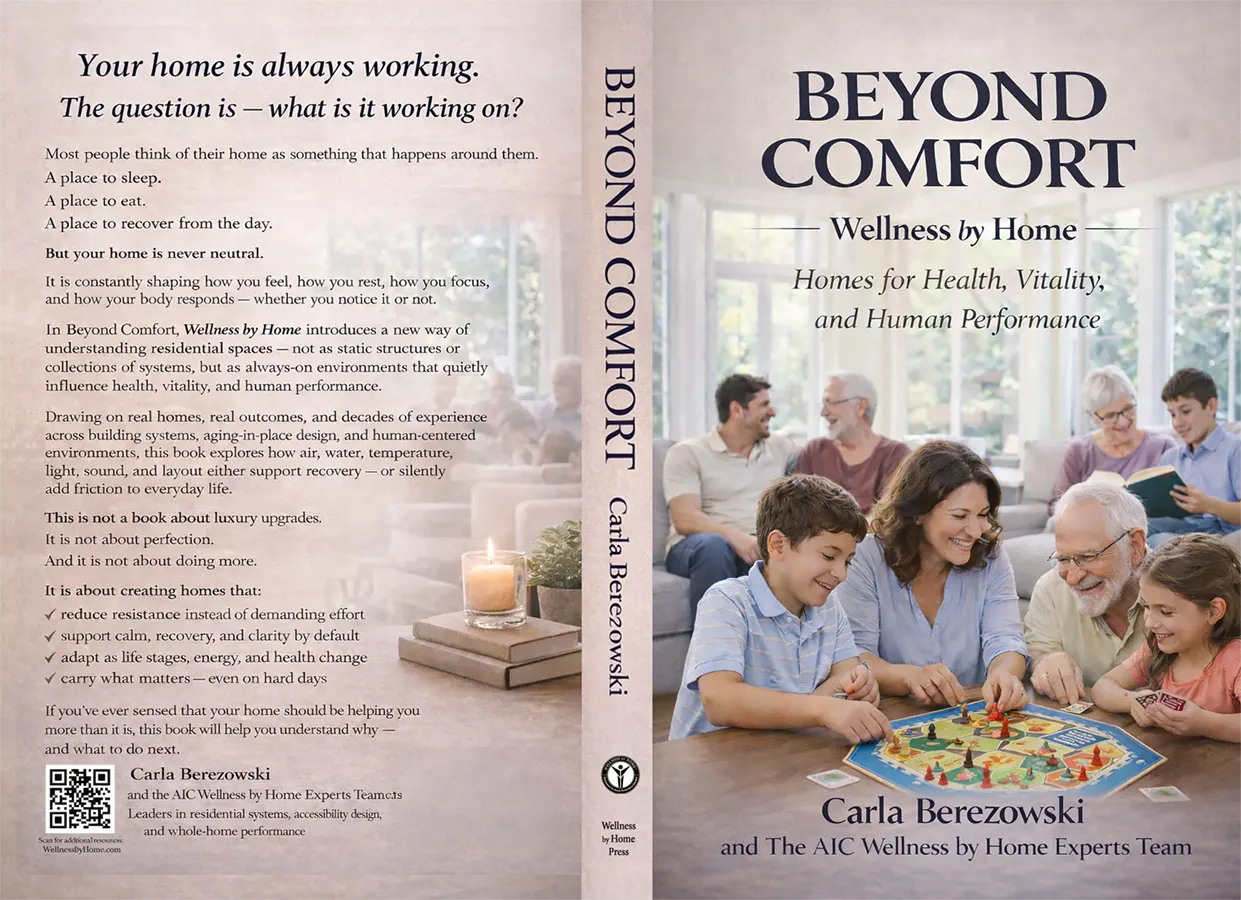
Begin seeing your home differently
Discover how the place surrounding you every day can become one of your most powerful, passive and enduring supports for a better life.